Kyle, TX · Hays County
AC repair in Kyle, TX
Most AC repair calls in Kyle come down to one of a few faults: a capacitor or contactor at the outdoor unit, a refrigerant leak, a clogged condensate drain in the attic, or airflow choked by a filter or a crushed duct. Which one it is decides whether the fix takes an hour or opens a replacement conversation.
The line is answered 24/7. Visits depend on which contractors are working your ZIP code.
What a technician checks first
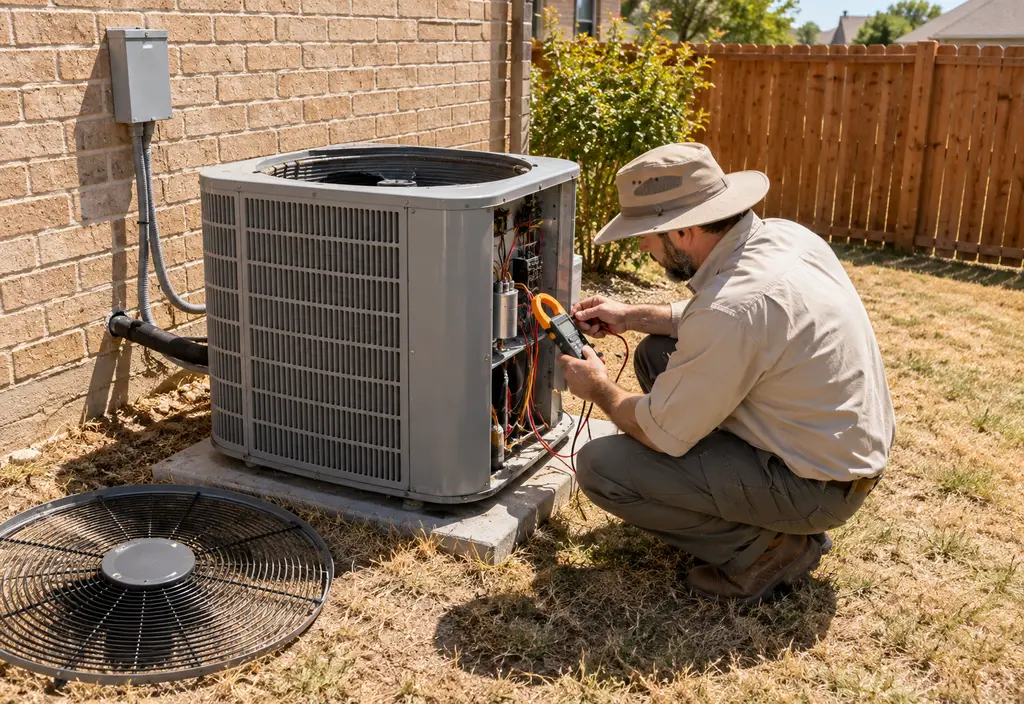
The order is roughly the same on every call. The thermostat: what it is set to, what the house reads, and whether it is actually calling for cooling. Then airflow: the filter, the return grille, and whether the attic blower is moving air. Then the outdoor unit: whether the fan and the compressor start, the capacitor, the contactor, and the current the compressor draws.
Then the measurements that separate one fault from another. The temperature drop between the return air and the supply air tells a technician whether the problem is airflow or refrigerant. Refrigerant pressures, superheat and subcooling say whether the system is undercharged, overcharged or restricted. Those are numbers off an instrument, and you can ask for them in writing.
Why Kyle systems fail in July and August
The NOAA 1991–2020 normals for San Marcos, the nearest station with published normals, show about 117 days a year at 90°F or warmer and an August average low near 74°F. A system here runs long cycles for months and gets little rest overnight. Capacitors that were weakening in May fail in the first long heat wave, and a refrigerant leak that was slow in spring shows up as warm air in August.
Many Kyle homes were built in the same few years. About 38% of the city's housing dates to 2000–2009 and 39% to 2010–2019, according to the Census American Community Survey (2020–2024). Systems installed together tend to wear out together, which is why one street can have several no-cooling calls in the same week.
Diagnostic visit and repair are separate
The contractor charges for the visit that finds the fault, on its own terms. The repair is quoted after the finding. Some contractors credit the diagnostic charge toward the repair if the work goes ahead the same day; some do not. Ask before the visit is booked.
When the repair stops making sense
A capacitor, contactor, fan motor or drain-line clearing is a repair on a system of any age. A failed compressor, or a leak in the attic coil of a system installed before 2010, is different: many of those systems run on R-22, which has not been produced since 2020, and the repair can cost a large share of a new system. That is the point to ask about AC replacement or a full system replacement.
What to have ready when you call
- What the system is doing: running but blowing warm, outdoor unit silent, ice on the lines, water at the attic unit
- The thermostat setting and the indoor reading
- The install year from the outdoor data plate, and the refrigerant listed there (R-22, R-410A, R-454B or R-32)
- Your address and ZIP code, attic access, and whether a gate or a dog stands between a technician and the outdoor unit
Common questions
Can it just be recharged? Refrigerant is not used up. A system that is low has a leak, and adding refrigerant without finding it buys weeks, not seasons. Ask whether a leak search is part of the visit.
The breaker trips when the AC starts. Do not keep resetting it. A breaker that will not hold is reporting a fault in the circuit or the equipment, often a failing capacitor or a compressor drawing too much current at startup.
Who is licensed to do this work? In Texas, HVAC contractors are licensed by TDLR. Ask for the license number and look it up before work starts.
Have the install year and the thermostat reading ready. Ask who is taking calls in your ZIP code today.
(888) 217-3739